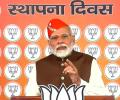
He also stressed that whether we look from the world point of view or from the national viewpoint, the responsibilities of each member of the BJP are constantly growing. "Each and every worker of the BJP is a representative of the country's dreams," added PM Modi.

The latest deal would give Facebook deeper access to India, the second largest internet market after China.

India's negotiating posture at the multilateral negotiations should be aligned with a significantly transformed development strategy domestically.' 'The positions the country takes at the negotiations will then carry credibility, says Shyam Saran, former foreign secretary and India's chief negotiator on Climate Change 2007-2010.

From the enactment of the capital control Act to the recognition of the BSE as a stock exchange and the infamous Harshad Mehta scam, here are the 18 biggest events for stock markets from 1947 to 1993.

Agnipath may be an exercise to address the genuine needs of the armed forces. But overall, it betrays the tendency to use the military and paramilitary for employment generation and shaping a national character, instead of treating them as the professional services they are, notes Shyam G Menon.

Legendary India players Sunil Gavaskar and VVS Laxman were of the view that making the showpiece event a 14-team affair with the inclusion of the likes of Afghanistan and Scotland would significantly diminish the level of competition in the league stage.

According to sources, Russian energy giant Rosneft or its affiliates, Saudi Aramco and Reliance Industries are in race for BPCL's three refineries - Mumbai, Kochi in Kerala and Bina in Madhya Pradesh - 16,309 petrol pumps, 6,113 LPG distributor agencies and more than a fifth of 256 aviation fuel stations in the country.

Tech Mahindra was the top laggard in the Sensex pack, cracking over 5 per cent, followed by Infosys, HDFC, IndusInd Bank, Reliance Industries and NTPC. On the other hand, Hero MotoCorp, L&T, Maruti, UltraTech Cement and Sun Pharma led the gainers' chart.

'For all of us at Amazon, it is 'Bharat first'.' 'We are keeping the Indian customer at the centre of what we are doing.'

Will open radio access network technology (O-RAN) disrupt the way 5G networks roll out in the country? After all, it promises to offer a substantially lower capital cost, enables the choice of an array of vendors, and provides more network flexibility - all very important for telcos who expect to invest over Rs 60,000 crore to roll out a pan-India 5G network and that's without spectrum costs. But more importantly, it counters the stranglehold of global telecom gear makers such as Ericsson, Nokia, and Samsung over telcos to whom they sell propriety technology and bundled hardware and software.
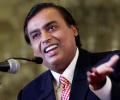
The deal, as well as some other strategic and financial investments in works, will help Ambani cut debt at RIL.

Prime Minister Narendra Modi has been ranked as the world's ninth most powerful person by Forbes magazine in a 2015 list which is topped by Russian President Vladimir Putin.

PowerGrid was the top laggard in the Sensex pack, shedding around 2 per cent, followed by Sun Pharma, ITC, ONGC, Bharti Airtel and Reliance Industries. On the other hand, Maruti, Nestle India, ICICI Bank and UltraTech Cement were among the gainers.

The secret to a healthy heart lies in living a stress-free, well-balanced lifestyle combined with regular physical activity and a good night's sleep, suggests cardiologist Dr Talha Meeran.
